

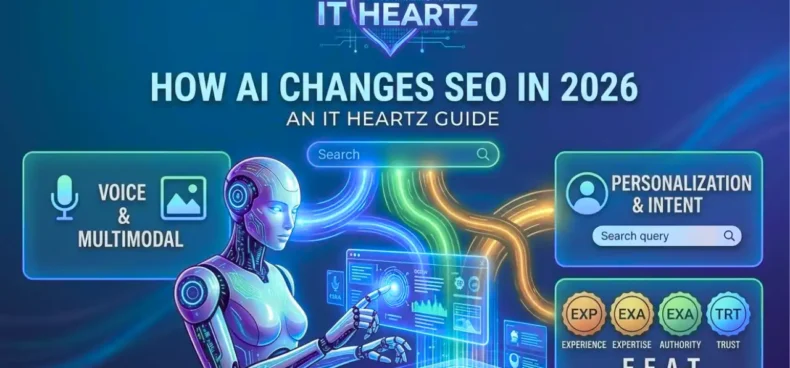
How AI Is Changing the Future of SEO in 2026 and Beyond
Search engine optimization is no longer just about keywords and backlinks. The rise of AI in SEO has completely transformed how websites rank, how content is created, and how strategies are built. Businesses today are asking one major question: How AI is changing SEO and what does it mean for the future of SEO? At IT Heartz, we have witnessed how AI and SEO together are reshaping digital marketing strategies. From smarter algorithms to automated insights, AI SEO is not just a trend , it is the foundation of modern search visibility. In this blog, we’ll explore how AI is changing the future of SEO, the tools driving this shift, and how businesses can adapt. The Evolution of SEO: From Keywords to Intelligence Traditional SEO relied heavily on manual keyword research, backlinks, and on-page optimization. But today, machine learning in SEO powers search engines. Google’s ranking systems now rely on AI search algorithms like RankBrain and BERT. These updates have shifted the future of SEO from keyword stuffing to intent satisfaction. The integration of artificial intelligence in digital marketing has made search engines smarter. They now understand context, semantics, and user behavior. This is where AI in SEO becomes critical. It helps marketers align with evolving ranking systems rather than chasing outdated tactics. AI Keyword Research is Smarter Than Ever One of the biggest revolutions in AI SEO is advanced keyword analysis. AI keyword research tools now: Modern AI SEO tools process massive datasets within seconds. Instead of guessing, businesses can rely on AI driven SEO strategies built on real-time insights. At IT Heartz, we integrate AI powered SEO systems to refine keyword targeting. This ensures strategies align with the future of SEO in 2026, not the past. The role of AI in search engine optimization has evolved beyond simple keyword matching , it now predicts behavior. AI Content Optimization & Automation Content remains central to AI and SEO integration. With the rise of AI content optimization, businesses can now: SEO automation tools powered by AI SEO tools streamline workflows and improve efficiency. However, automation without strategy can weaken authority. That’s why at IT Heartz, we combine AI powered SEO systems with human expertise. This hybrid approach ensures content aligns with AI and Google ranking factors while maintaining authenticity. Many wonder: Is AI replacing SEO experts?The answer lies in collaboration, not replacement. AI in Technical SEO Technical SEO has also been transformed by AI in SEO. Today, AI in technical SEO enables: Advanced AI search algorithms evaluate site performance faster than ever. Businesses using AI driven SEO strategies can detect issues before they impact rankings. Through SEO automation, repetitive technical tasks are simplified, allowing teams to focus on strategy. The impact of AI on search engines has made technical compliance more critical than ever. AI Search Algorithms & Google’s Evolution Google now operates using sophisticated AI search algorithms that interpret intent rather than exact-match keywords. Systems like: are redefining how results appear. The Search Generative Experience SEO shift highlights how AI-generated summaries are influencing click behavior. This transformation clearly shows how AI is changing SEO at its core. The future of SEO will rely heavily on machine learning in SEO, predictive models, and user-focused ranking systems. Predictive SEO & Data-Driven Growth One of the most powerful developments in AI SEO is Predictive SEO. Instead of reacting to trends, businesses can forecast them. With AI powered SEO, companies can: At IT Heartz, we use AI driven SEO strategies to prepare clients for algorithm shifts before they happen. The future of SEO in 2026 will belong to brands that leverage predictive intelligence instead of manual guesswork. AI for Local & E-commerce SEO The application of AI in SEO extends into niche markets as well. These applications show the growing influence of artificial intelligence in digital marketing across industries. The role of AI in search engine optimization is expanding beyond traditional websites into voice search and personalized experiences. Challenges of AI in SEO While AI and SEO integration offers advantages, challenges exist: Businesses relying only on SEO automation without strategic oversight may struggle. This is why agencies like IT Heartz focus on balancing automation with expertise. The Future of SEO: Human Intelligence + AI The real transformation isn’t AI replacing humans. It’s humans mastering AI SEO. The future of SEO depends on: At IT Heartz, we believe how AI is changing the future of SEO is not about removing professionals , it’s about empowering them. The brands that adapt early to AI driven SEO strategies will dominate rankings in the coming years. Conclusion The integration of AI in SEO is redefining digital marketing. From AI search algorithms to Predictive SEO, automation is reshaping how rankings are achieved. The future of SEO in 2026 will not belong to businesses resisting change. It will belong to those embracing AI and SEO collaboration. Understanding how AI is changing SEO allows brands to build smarter strategies. At IT Heartz, we combine advanced AI powered SEO systems with strategic human oversight to help businesses grow sustainably in an AI-driven world. The transformation has already begun , and the future of SEO belongs to intelligent adaptation. FAQs 1. How AI is changing the future of SEO? AI is transforming search by improving intent analysis, predictive insights, and automated optimization processes, making SEO more data-driven and intelligent. 2. What is the role of AI in search engine optimization? The role of AI in search engine optimization includes keyword clustering, AI content optimization, technical audits, and interpreting AI search algorithms. 3. Is AI replacing SEO experts? AI enhances efficiency, but strategic thinking, brand authority, and EEAT compliance still require professional oversight. 4. How does AI affect Google ranking factors? AI and Google ranking factors now focus more on user intent, experience signals, and contextual understanding powered by machine learning in SEO. 5. What is the impact of AI on search engines? The impact of AI on search engines includes conversational results, predictive ranking systems, and Search Generative Experience SEO integration.
Explore More
